
Aviation A to Z
VFR
Visual Flight Rules
Last checked November 2026
What it means
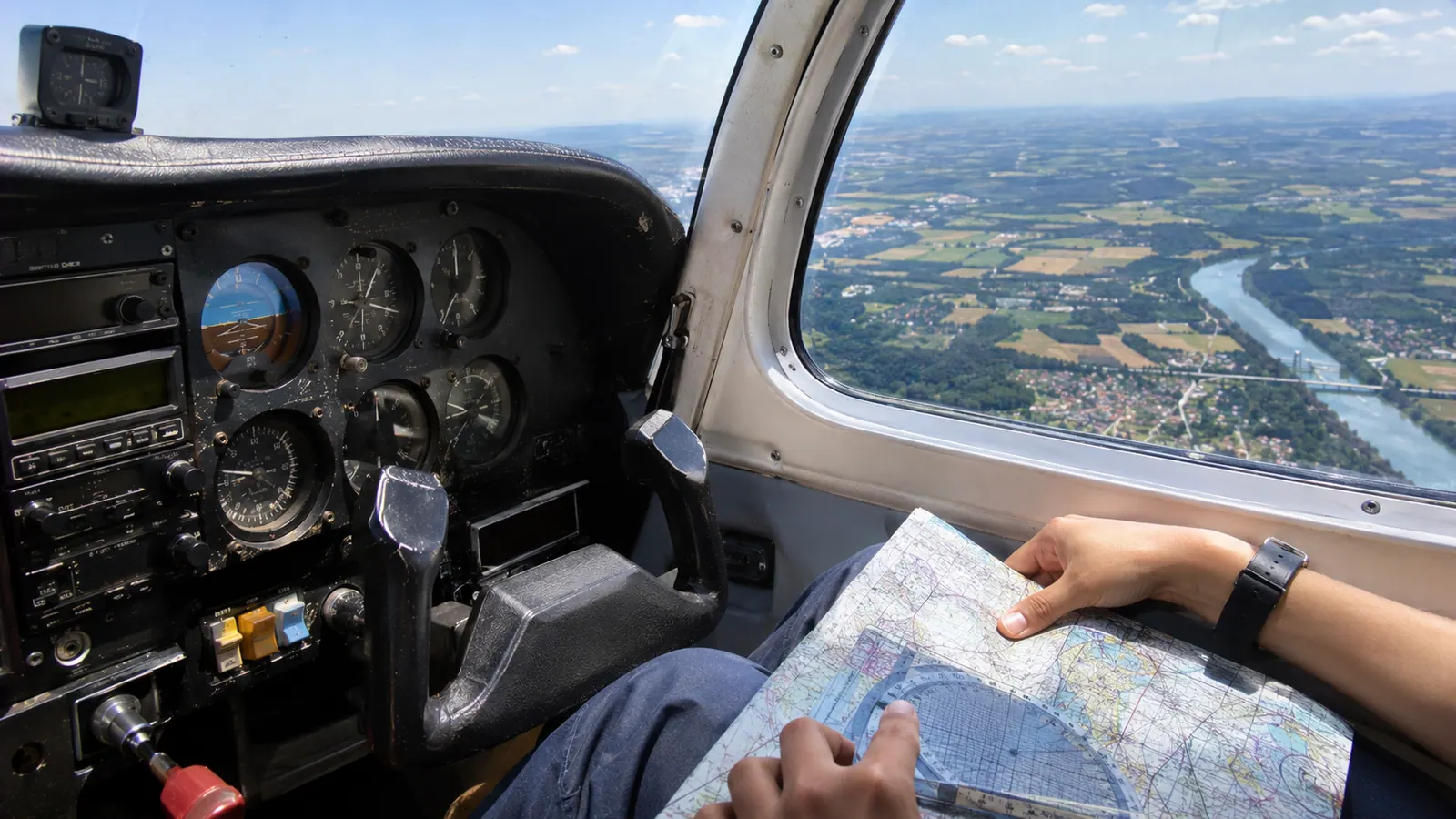
VFR are the rules for flight in visual conditions. A VFR flight needs weather with enough visibility and distance from clouds. Those limits are called the VFR weather minimums.[1][2]
Why it matters for student pilots
Your private pilot training is built around VFR flying. On the FAA test, you must identify and follow the basic VFR weather minimums.[6]
Worked example
Example: choosing a VFR cruising altitude
In the United States, VFR flights cruising more than 3,000 feet above the surface use set altitudes. The rule depends on your magnetic course. The two courses below are invented.[3]
- Course 045 Courses from 0 to 179 degrees use an odd thousand plus 500 feet. You could pick 5,500 feet.[3]
- Course 225 Courses from 180 to 359 degrees use an even thousand plus 500 feet, such as 6,500 feet.[3]
The two altitudes show the rule only. Terrain, airspace and ATC instructions may call for a different choice.
Where you meet it in training
Picking an altitude that fits the VFR cruising rules, terrain and wind is part of cross-country planning on the FAA private pilot test.[6]
Common misunderstandings
-
Often heard: VFR is only a word for good weather.
In fact: In US usage it means three things: the rules, weather at or above the VFR minimums, and a type of flight plan.[1]
How EASA, FAA and CASA differ
Practice it
Train it with the Abbreviations trainer in Practice, free with your account.
Abbreviations
Try it
A few questions from the Abbreviations trainer. No account needed, nothing is saved.
Sources
- FAA, Pilot/Controller Glossary, V (Visual Flight Rules), checked 18 Nov 2026
- eCFR, 14 CFR 91.155 (Basic VFR weather minimums), checked 18 Nov 2026
- eCFR, 14 CFR 91.159 (VFR cruising altitude or flight level), checked 18 Nov 2026
- FAA, Aeronautical Information Manual, Chapter 3, Section 2 (3-2-2, Class A Airspace), checked 18 Nov 2026
- EASA, Easy Access Rules for Standardised European Rules of the Air, SERA.5005(d) (Visual flight rules), checked 18 Nov 2026
- FAA, Private Pilot Airplane Airman Certification Standards (FAA-S-ACS-6C), Area I, Task D (Cross-Country Flight Planning) and Task E (National Airspace System), checked 18 Nov 2026