
Aviation A to Z
GNSS
Global Navigation Satellite System
Last checked November 2026
What it means
GNSS is the general name for satellite navigation. GPS, the US system, is one example. A receiver in the aircraft uses signals from several satellites to work out its position. Pilots use it to navigate and, with approved equipment, to fly instrument approaches.[1][2]
Why it matters for student pilots
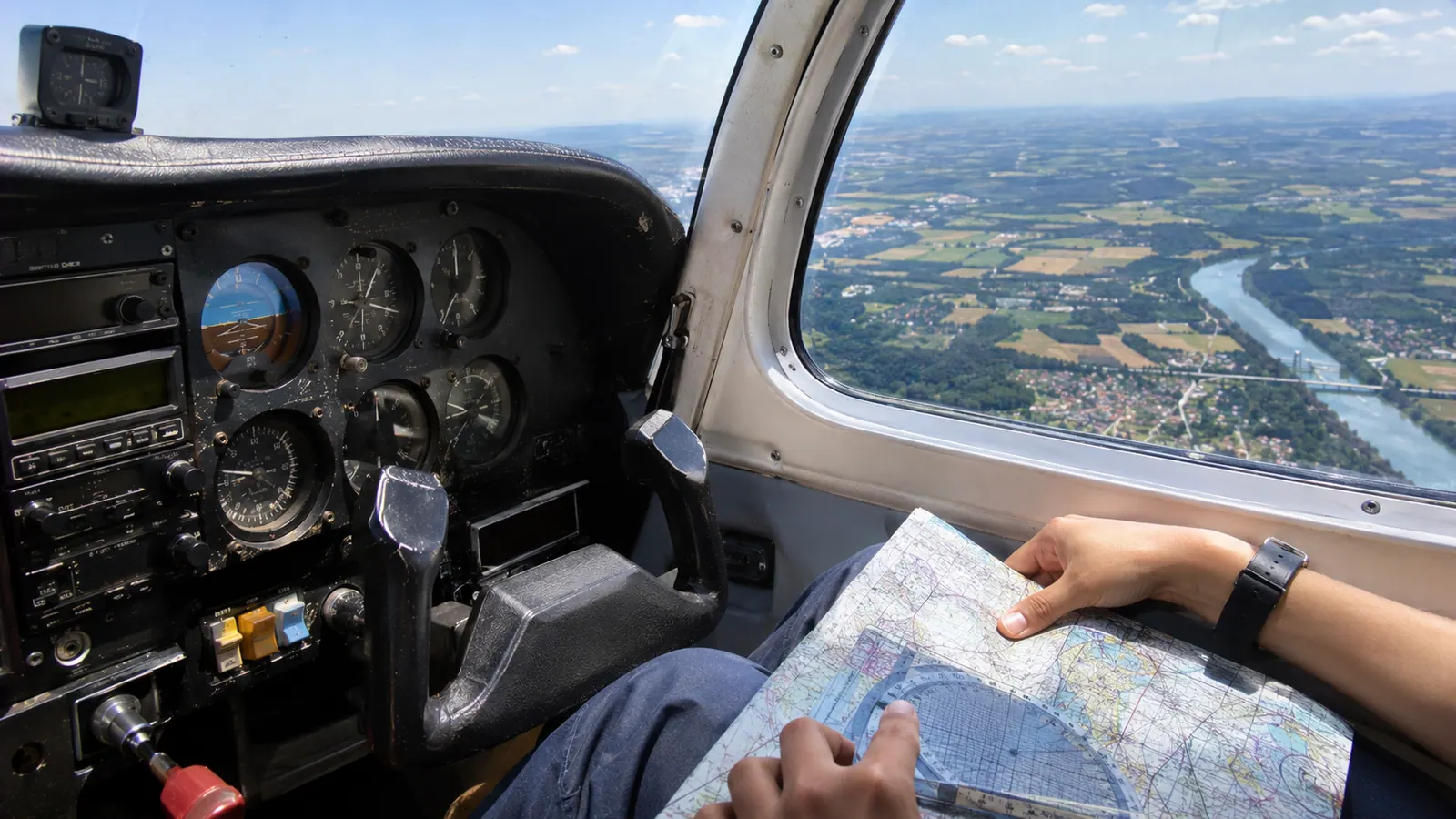
Satellite navigation is used for both VFR and IFR flying. You still learn to find your way by chart, clock and compass, because the signal can be lost.[2][3]
Worked example
Example: how many satellites your receiver needs
These counts come from the FAA's description of GPS. They show why a receiver can display a position and still warn you.[2]
- Four satellites A receiver needs at least four satellites for a position in three dimensions, including height.[2]
- Five satellites To check its own position for errors, the receiver needs one more. This self check is called RAIM. Four satellites plus barometric altitude can also work.[2]
- Six satellites To find a bad satellite and leave it out, a receiver needs six, or five plus barometric altitude.[2]
- The design The GPS constellation has 24 satellites. It is designed so that at least five are in view anywhere in the world.[2]
The counts teach the idea. Your own receiver's manual sets the rules for that equipment.
Where you meet it in training
On the FAA private pilot test, satellite navigation is a knowledge item, including RAIM and the use of databases. You must also recognize a lost or disturbed signal and act on it.[3]
Common misunderstandings
-
Often heard: A handheld GPS will warn me if its position is wrong.
In fact: Handheld and VFR panel receivers have no RAIM alerting. Cross-check them with other navigation, and doubt the GPS when the two disagree.[2]
-
Often heard: GPS outages are too rare to plan for.
In fact: The FAA notes that GPS interference and outages have become more common. Some US airline rules require a way to navigate that does not use GPS.[2]
Practice it
Train it with the Abbreviations trainer in Practice, free with your account.
Abbreviations
Try it
A few questions from the Abbreviations trainer. No account needed, nothing is saved.
Sources
- FAA, Pilot/Controller Glossary, G (Global Navigation Satellite System; Global Positioning System), checked 18 Nov 2026
- FAA, Aeronautical Information Manual, Chapter 1, Section 1 (1-1-17, Global Positioning System), checked 18 Nov 2026
- FAA, Private Pilot Airplane Airman Certification Standards (FAA-S-ACS-6C), Area VI, Task A (Pilotage and Dead Reckoning) and Task B (Navigation Systems and Radar Services), checked 18 Nov 2026