
Aviation Connect
Log in Sign up free
Bankstown Airport, Sydney

Country guide

Australia

Oceania

English-language CASA training a short flight from home, on one student visa that lets you work while you train.

  • AUD 167k–216k Total budget, estimated
  • 14–24 Months of training
  • CASA CPL + MEIR License
  • Subclass 500 Student visa

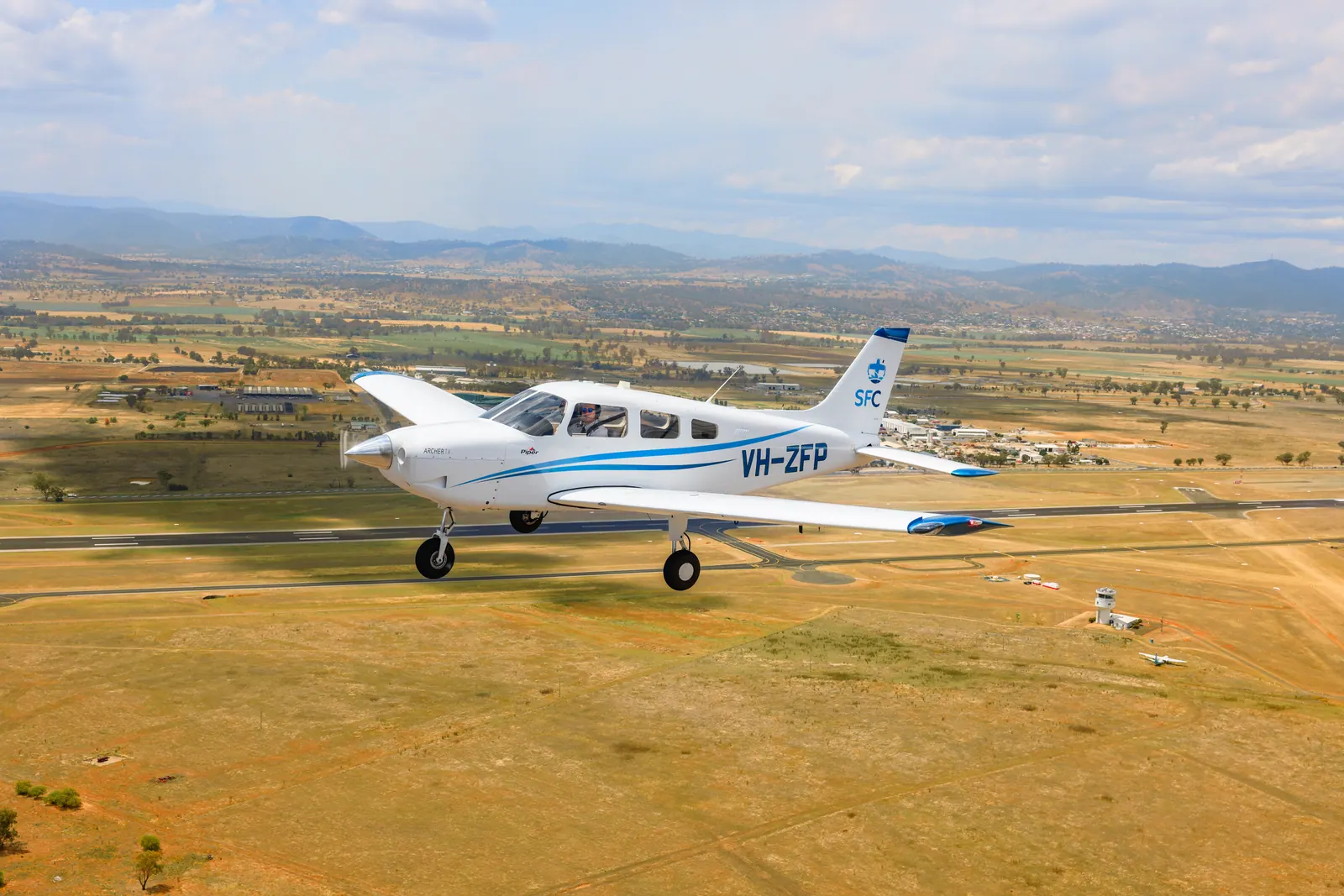
Bankstown Airport, Sydney. Photo: Beau Giles, CC BY 2.0, via Wikimedia Commons.

01 Overview

Flight training in Australia.

Australia is one of the most popular destinations for pilot trainees from across Asia-Pacific. The reasons are practical: short flights home, an English-language environment, CASA licences that follow ICAO standards and that most regulators in the region will convert, and a single student visa that can lead to a post-study work visa. The trade-offs are cost, as Australia is mid-to-upper priced globally, and stricter student visa rules in 2026: closer Genuine Student (GS) checks, a higher visa charge since July 2026 and new limits on bringing family since October 2026.

Key facts

Primary license
CASA CPL (ICAO-recognised)
Typical duration
10-24 months
Course fee (CPL or CPL with MEIR)
From AUD 108,738 (CPL only) to about AUD 170,000 (CPL with MEIR)
English requirement
IELTS 6.0 or equivalent (some schools ask 6.5) + ICAO Level 4 for the licence
Medical requirement
CASA Class 1 medical
Main training regions
Queensland, New South Wales, Victoria, South Australia, Western Australia
Visa
Subclass 500 (Student visa)
Post-training work rights
Subclass 485 (up to 18 months after a diploma, 2-3 years after a degree; conditions apply)

02 Costs

What training in Australia costs.

Australian flight training costs more than Southeast Asia and many European schools, and is broadly comparable to the US. The figures below cover zero-to-CPL training for international students at CRICOS-registered providers, plus the typical living costs. Note that Australia's financial-capacity requirement of AUD 29,710 per year (about USD 20,700) is a Department of Home Affairs threshold you must demonstrate for the visa. It isn't what you'll actually spend, just the minimum proof required.

Most airline-track students take the CPL together with the Multi-Engine Instrument Rating (MEIR) as one diploma package, from about AUD 137,000 (about USD 95,000).

Estimated costs · AUD

  • Course fee: Diploma of Aviation (CPL only) From AUD 108,738 (about USD 75,700) at our partner schools. Other CRICOS-registered schools publish CPL-only diplomas from about AUD 89,500 to 119,070 in 2026. What is included (flight hours, aircraft, exam fees) differs between schools, so compare like with like. Estimated range AUD 108,738–120,000
  • Course fee: CPL with Multi-Engine Instrument Rating (MEIR) About USD 95,000-118,000. The combined diploma package most airline-track students choose. Variation reflects school, location, flight hours and aircraft fleet. Estimated range AUD 137,000–170,000
  • Living expenses (12 months) About USD 18,000-28,000. Rent is the biggest variable: regional towns cost less, Sydney and Melbourne the most. Estimated range AUD 26,000–40,000
  • Subclass 500 visa application charge AUD 2,500 since 1 July 2026. AUD 2,050 with a passport from an ASEAN country (such as Brunei, Indonesia, the Philippines, Thailand or Vietnam). Not refunded if the visa is refused. Estimated range AUD 2,050–2,500
  • Overseas Student Health Cover (OSHC) Mandatory for the full visa duration. Offered by ahm, Allianz Care, Bupa, Medibank and nib; cost varies by provider. Estimated range AUD 600–900 per year
  • Financial capacity proof (Home Affairs threshold) About USD 20,700. You must demonstrate access to this amount per year of stay. Not a fee: a financial documentation requirement. If you can include family (see the visa section), add AUD 10,394 for a partner and AUD 4,449 per child. Estimated range AUD 29,710 per year, single applicant
  • CASA Class 1 medical (first issue) Includes CASA's AUD 75 processing fee. Examiner fees are set by each clinic, and the first Class 1 needs extra tests such as an ECG. Must be done by a CASA Designated Aviation Medical Examiner (DAME). Estimated range AUD 600–1,000
  • IELTS or equivalent English test IELTS costs AUD 490 in Australia in 2026; at home it is priced in local currency. IELTS, TOEFL iBT, PTE Academic and Cambridge are accepted, but online and at-home versions are not. Estimated range AUD 350–490
  • CASA ATPL theory exams (7 subjects) About AUD 176 per exam and AUD 206 for flight planning (CASA fee plus invigilator fee). Resits are charged again. Estimated range AUD 1,260
  • Textbooks, headset, navigation equipment Most schools sell starter kits. Estimated range AUD 1,500–3,000

Estimates as of October 2026: verify every figure with the school before you commit. The estimated total budget adds the course fee, 12 months of living costs and the fixed costs in the table for the visa, the medical, exams and insurance; a longer course adds the living costs of the extra months. Check Home Affairs thresholds and visa charges on the Home Affairs website before you apply. USD figures use the exchange rate on our site in October 2026.

Your own total for the route and the school you have in mind, living costs included: an honest range in about 30 seconds, no email needed.

Estimate your budget for Australia

03 Visa

Your student visa for Australia.

Australia uses a single visa for all international students regardless of qualification level: the Subclass 500 Student Visa. There is no separate vocational/academic split as in the US. This simplifies the path, but the 2026 rules are stricter than they were two years ago: the Genuine Student (GS) requirement, a higher visa charge since 1 July 2026 and, since 2 October 2026, limits on including family members and on applying for a further Student visa from inside Australia.

Australia also has a post-study work visa, the Subclass 485, which lets graduates work in Australia for 18 months to 5 years depending on their qualification and passport. For pilots it can help with building flight hours and experience, but a diploma alone does not guarantee you qualify, so read the conditions below before you count on it.

500

Subclass 500: Student visa

The single Australian student visa, covering all international students at CRICOS-registered providers. Issued by the Department of Home Affairs after you receive a Confirmation of Enrolment (CoE) from your school.

Duration

Valid for the duration of your course. Most CPL diplomas take 10-24 months; some integrated bachelor-degree programs extend the visa to 3-4 years.

Who can apply

  • Confirmation of Enrolment (CoE) from a CRICOS-registered flight school
  • Meet the Genuine Student (GS) requirement: show your study choice is consistent with your background and goals
  • Demonstrate financial capacity (AUD 29,710 per year for the main applicant)
  • Meet English requirements (typically IELTS 6.0 or equivalent)
  • Overseas Student Health Cover (OSHC) for the full duration
  • Pass health and character checks (you may be asked for police certificates from the countries you have lived in)

Pros

  • Single visa covers everything, no separate vocational/academic distinction
  • 48 hours of paid work per fortnight allowed during course sessions
  • Unlimited work during scheduled course breaks
  • Students with a passport from an ASEAN or Pacific country can still include a partner and dependent children
  • Multiple-entry travel: leave and re-enter Australia freely
  • A possible next step to the Subclass 485 post-study work visa (see its conditions below)

Trade-offs

  • Visa charge of AUD 2,500 since 1 July 2026 (AUD 2,050 with a passport from an ASEAN country), not refunded if the application is refused
  • Since 2 October 2026, most students can no longer include family members; exceptions include ASEAN and Pacific passport holders, doctoral students and some government-sponsored students
  • If your training runs past your visa, a further Student visa must now usually be applied for from outside Australia (exceptions include up to 12 more months with the same school)
  • Applicants from India, Nepal, Bangladesh and Bhutan moved to the highest evidence level on 8 January 2026, which means more document checks and often longer processing
  • You must maintain enrolment, attendance, and academic progress: the visa can be cancelled for non-compliance
Official information

485

Subclass 485: Temporary Graduate visa

The post-study work visa. It lets recent graduates live and work in Australia with unlimited work rights. How long you get depends on your qualification and passport: up to 18 months after a diploma, usually 2-3 years after a degree, and 5 years for Hong Kong and British National (Overseas) passport holders. For a pilot diploma, eligibility is not automatic: see the conditions below.

Duration

Post-Vocational Education Work stream: up to 18 months. Post-Higher Education Work stream: usually 2-3 years, depending on the degree. Hong Kong and British National (Overseas) passport holders: 5 years. Degree graduates who studied and lived in a regional area can apply for a second 485 of 1-2 years.

Who can apply

  • A qualification from a CRICOS-registered course completed in the 6 months before you apply
  • Diploma graduates apply in the Post-Vocational Education Work stream, which requires an occupation on the Medium and Long-term Strategic Skills List (MLTSSL) closely related to your course, plus a skills assessment. Check with a registered migration agent whether an aviation diploma meets this before you plan around it
  • Graduates with a bachelor degree or higher apply in the Post-Higher Education Work stream, which has no occupation list
  • Have held a Student visa in the last 6 months
  • Be 35 or younger when you apply (Hong Kong and British National (Overseas) passport holders up to 50)
  • English: IELTS 6.5 overall with at least 5.5 in each band, or an equivalent test, taken in the year before you apply
  • Pass health and character checks and hold adequate health insurance

Pros

  • Work in any job, for any employer, without restriction
  • Build flight hours as a flight instructor (with a Flight Instructor Rating) while earning a wage
  • Australian work experience can help if you later apply for skilled migration
  • Can travel in and out of Australia freely
  • Degree graduates who studied in a regional area can apply for a second 485 of 1-2 years

Trade-offs

  • The application charge rose to AUD 5,750 on 1 July 2026 for most applicants (it was AUD 2,300 until March 2026)
  • Must apply within 6 months of course completion (don't delay)
  • A pilot diploma alone may not qualify: the vocational stream needs a listed occupation and a skills assessment
  • Higher English score than the Student visa (IELTS 6.5)
  • Not a guaranteed pathway to permanent residency: a separate skilled migration application is still required
Official information

04 Requirements

English and medical: what you need.

English

Australian flight training requires English at two stages:

  • For the Subclass 500 visa and school entry: IELTS 6.0 (or equivalent) is the typical requirement for CPL diplomas, and some schools ask for 6.5. Lower scores (IELTS 5.0-5.5) can be accepted if you take an English course (ELICOS) of 10-20 weeks before your aviation training.
  • For the CASA pilot licence: You must achieve ICAO Level 4 English Language Proficiency or higher. This is assessed by a CASA-approved aviation English assessor, separately from your visa English test. A good IELTS score helps, but it does not replace this assessment.

Home Affairs also accepts PTE Academic, TOEFL iBT, Cambridge C1 Advanced, OET and other tests at equivalent scores. The equivalent scores changed for tests taken from 7 August 2025, and online or at-home tests are not accepted. Check the current table on the Home Affairs website before booking your test.

Medical

You need a CASA Class 1 medical certificate to start commercial pilot training in Australia. The Class 1 is the strictest level and is required for all commercial flying.

The medical must be performed by a CASA Designated Aviation Medical Examiner (DAME). CASA has DAMEs in Australia and overseas, so you may be able to take it before you leave home: check CASA's list of examiners. Many international students complete it in Australia shortly after arrival, but getting it before you pay tuition is safer. If a condition rules you out, you want to know first.

Expect CASA's AUD 75 processing fee plus the examiner's charges, which CASA does not set; with the extra tests for a first Class 1, such as an ECG, budget roughly AUD 600-1,000. Common reasons for refusal include vision that cannot be corrected to the standard, certain heart conditions, a history of seizures and some mental health conditions. Colour vision deficiency does not automatically rule you out: CASA accepts further tests, including the CAD test and a practical assessment. CASA publishes detailed medical standards: review them before committing financially to training.

05 Training there

Training and living in Australia.

Worth knowing

Genuine Student (GS) requirement: this is what 2026 hinges on

Since 23 March 2024, applicants must answer targeted questions in their Subclass 500 application to show they are genuine students. Your course must logically follow your academic and professional history, and you must show how it fits your career plans. Generic or copied answers, a study path that does not fit your background and inconsistent financial documents are common reasons for refusal. We explain what the questions ask and what evidence helps, but the answers must be your own: templated answers are easy for case officers to spot.

Where to train: regional differences

  1. Queensland (Gold Coast, Brisbane, Sunshine Coast, Toowoomba)

    Subtropical climate, consistent flying weather, large concentration of established schools. Support for international students is well established.

  2. South Australia (Adelaide / Parafield)

    Adelaide is one of the most cost-effective major cities for international students. Parafield Airport hosts several long-established schools. Mild climate, less cyclone and storm disruption than the tropical north.

  3. Western Australia (Jandakot, Murray Field)

    Usually cheaper to live in than Sydney and Melbourne. Excellent year-round flying weather. Time-zone alignment with most Asian markets is convenient for family contact.

  4. New South Wales (Bankstown, Camden, Tamworth, Wagga Wagga)

    Strong school network, but Sydney living costs are among the highest in Australia. Regional NSW (Tamworth, Wagga Wagga) costs less to live in and counts as regional study for skilled migration points.

  5. Victoria (Moorabbin, Melbourne)

    University-affiliated programs (RMIT, Swinburne). Melbourne living costs are second only to Sydney. Variable weather limits flying days compared to QLD/SA.

Worth knowing

Regional study: what it adds, and for whom

Most of Australia outside the Sydney, Melbourne and Brisbane metropolitan areas counts as regional, including cities such as Perth, Adelaide, Gold Coast, Hobart and Canberra. Studying there earns 5 extra points on the skilled migration points test. Graduates of a bachelor degree or higher who studied and lived in a regional area can also apply for a second Subclass 485 of 1-2 years. That second visa is not open to diploma graduates, so for a CPL diploma the main benefit of a regional school is lower living costs.

Timeline: what a typical CPL pathway looks like

  1. Months 1-3: Recreational Pilot Licence (RPL) Foundational training in single-engine aircraft. Covers basic navigation, controls, communications. First solo around month 2-3. CASA RPL flight test at end of phase.
  2. Months 4-6: Private Pilot Licence (PPL) Cross-country navigation, controlled airspace operations, radio procedures. PPL theory exam and CASA flight test.
  3. Months 7-11: Commercial Pilot Licence (CPL) Time building, advanced manoeuvres, complex aircraft systems, commercial operations theory. CASA CPL theory exams and the CPL flight test.
  4. Months 12-15: Multi-Engine Instrument Rating (MEIR) Airlines expect it, so most airline-track students take it, usually as part of a combined CPL and MEIR diploma (see the costs above).
  5. Month 16+: ATPL theory and time building Pass the 7 ATPL theory subjects. Many graduates then build hours as flight instructors (after a Flight Instructor Rating), where their visa allows them to work, toward the experience regional airlines and charter operators ask for.

07 7 questions

Questions about training in Australia.

How long does the Subclass 500 visa application take?

It depends on your passport, your school and how complete your application is. Home Affairs publishes current processing times on its website as a guide based on recently decided applications.

Since 8 January 2026, applicants from India, Nepal, Bangladesh and Bhutan face the highest evidence level, with more document checks, which often means longer processing. Apply at least 3-4 months before your course start date.

Will my CASA license be recognised in my home country?

In most cases yes, through a conversion. CASA licences are ICAO-compliant and widely respected, and most aviation authorities in the region have a process for converting a foreign licence. It usually means written exams on local air law, a check flight and sometimes extra training.

Requirements, costs and timelines differ by country and change over time, so check with your home authority, or the airline you want to fly for, before you enrol.

Can I work while studying?

Yes. Subclass 500 holders can work up to 48 hours per fortnight (roughly 24 hours per week) during course sessions, and unlimited hours during scheduled course breaks. You cannot start work before your course begins.

Most pilot students don't work during training because the workload is heavy, but the option exists for living-cost support.

What is OSHC and is it mandatory?

Overseas Student Health Cover is mandatory health insurance for the full duration of your Subclass 500 visa. It costs about AUD 600-900 per year per student. It is offered by ahm, Allianz Care, Bupa, Medibank and nib.

You must have OSHC in place from the day you arrive in Australia for your whole stay.

Can I bring my partner or family?

Only in some cases since 2 October 2026. Most new Student visa applications can no longer include a partner or children. Exceptions include students with a passport from an ASEAN country (such as Brunei, Indonesia, the Philippines, Thailand or Vietnam) or a Pacific country, doctoral students and some government-sponsored students.

Family members cannot be added after the visa is granted, so they must be in the same application. If you can include them, each one adds to the financial capacity requirement: AUD 10,394 per year for a partner and AUD 4,449 per child.

What is the path to permanent residency from a pilot course?

Studying doesn't lead to PR on its own, and for pilots the path is narrow. Pilots are assessed by CASA for skilled migration, which expects professional flying experience, and which visas are open to the occupation depends on the current occupation lists.

Most pilots who stay do so through an employer or a state nomination after years of flying. Australian study earns 5 points on the points test, plus 5 more for regional study. Rules change often, so treat permanent residency as a possible bonus, not the plan, and check with a registered migration agent.

Why is the visa fee so high?

The Subclass 500 charge rose to AUD 2,500 on 1 July 2026, up from AUD 2,000 (and AUD 1,600 before July 2025). Students with a passport from an ASEAN country (such as Brunei, Indonesia, the Philippines, Thailand or Vietnam) pay a lower AUD 2,050.

The increases are part of wider changes to manage international student numbers: for 2026 the government set a National Planning Level of 295,000 new international students. The fee is non-refundable even if your application is refused, so preparing a strong application matters more than ever.

Our school advisory is free for students

Questions about Australia?
Talk it through with us.

One call with an advisor about the schools, the visa and the costs in Australia. Free for students, and you decide.

Free for students Create free account