
Guide · Selection
Pilot aptitude tests, explained.
Before a school or an airline invests in you, it wants to know whether you can learn to fly. Aptitude tests measure exactly that: how you think, react and cope under pressure. Here is what they test, where you will meet them, and how to practice every area for free.
Last checked November 20266 min read
- 4 areas What selection tests look at
- 12 modules In our free full practice test
- 5 minutes Our free practice screening
- No signup To start the screening
01 Pilot aptitude tests
What aptitude tests are for
An aptitude test does not check what you already know about flying. It predicts how well you will learn it. Schools and airlines use the results to compare candidates and decide who goes on to the next stage. The test itself usually does not say pass or fail; the school or airline makes that decision.
02 Pilot aptitude tests
What they look at
Selection tests in aviation usually cover four areas:
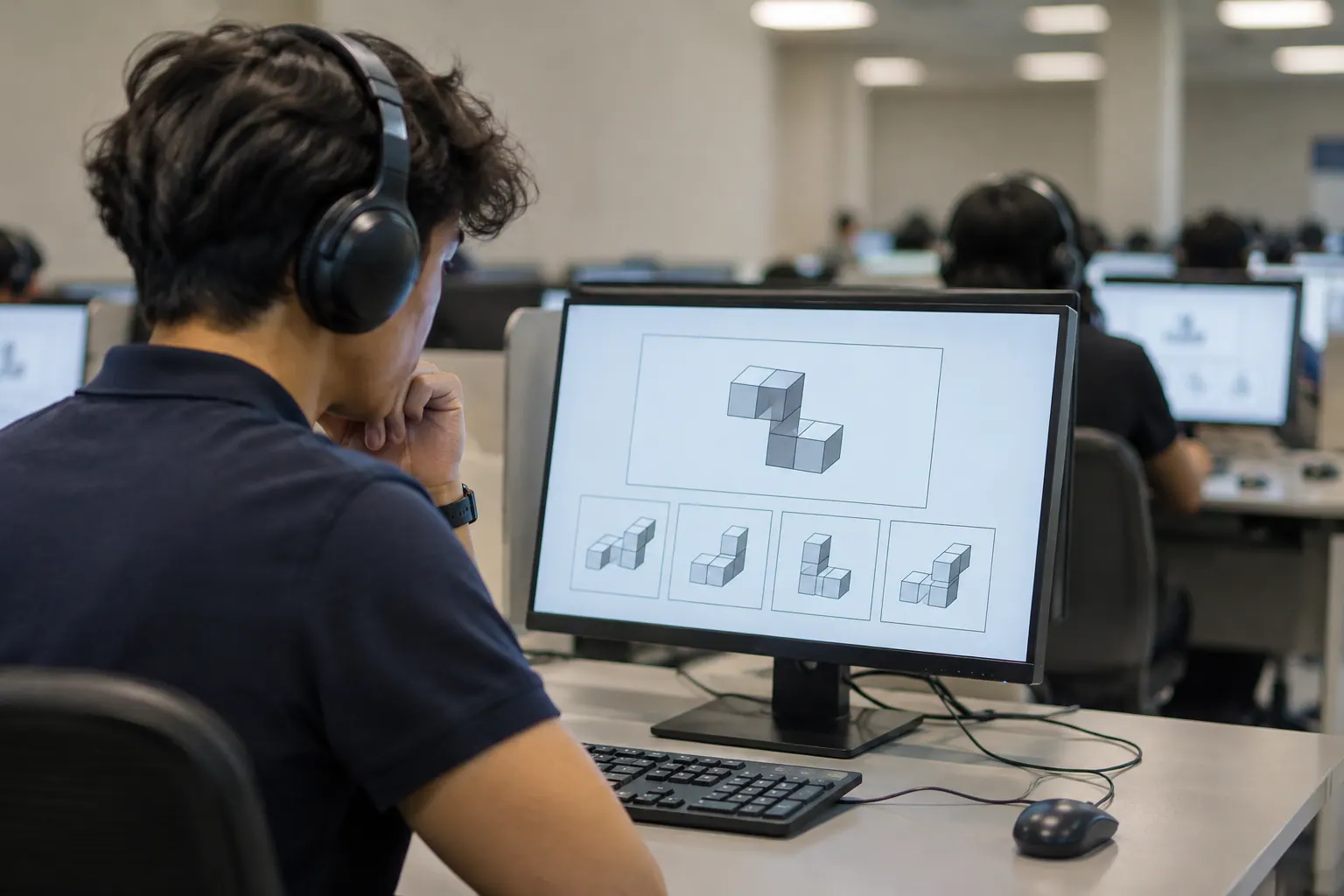
- Mental performance: memory, spatial awareness, mental math and attention.
- Operational skills: multitasking, quick decisions and handling several sources of information at once.
- Social skills: teamwork and communication, often in group exercises.
- Personality: how you handle stress, rules and responsibility.
Many tests add English and some technical knowledge, and some measure hand and eye coordination with a joystick.

03 Pilot aptitude tests
Area by area, and where to practice it
Every area below links to where you can practice it with us, for free. The practice screening needs no signup; the full practice test and the trainers come with a free account.
Our tests are practice tools to help you prepare. They are not an official selection test of any school, airline or aviation authority, and they do not replace one.
- Free practice screening Free practice screening, no signup
- Full practice test Full practice test, free account
- Flight maths Practice trainer, free account
-
Mental math.
Speed, time, distance and fuel, worked out in your head.
-
Spatial orientation.
Reading an attitude indicator at a glance: climbing, descending, banking which way.
-
Color vision.
Telling lights, charts and displays apart by their color. This is not a medical test. Only an aviation medical examiner can assess your color vision.
-
Reaction time.
How fast and how accurately you respond to a signal.
-
Multitasking.
Keeping several tasks going without dropping one.
-
Memory.
Holding numbers, call signs and instructions in your head.
-
Attention and vigilance.
Staying sharp over time and spotting the one thing that changed.
-
Pattern recognition.
Seeing the rule behind a sequence quickly.
Practice it: Full practice test free account -
English.
Understanding instructions and radio calls in aviation English.
-
Situational judgment.
Choosing a sensible action in a realistic situation. There is no trick to it: answer as the pilot you want to be.
Practice it: Full practice test free account -
Technical knowledge.
Basic physics and aviation terms.
-
Teamwork.
Usually tested in person, in group exercises and interviews. Tip: listen, speak clearly and help the group reach a result.
04 Pilot aptitude tests
Where you meet aptitude tests
You will usually meet aptitude tests twice on the way to the cockpit: when some flight schools decide whom to admit, and later when you apply to an airline as a licensed pilot. Each school and airline runs its own process, but airline selection usually moves through similar stages.
- Application and documents
- Online tests
- Aptitude test
- Interviews and group exercise
- Medical
- English test
Practicing early pays off twice: once for your school, and again when you apply to an airline.
Many flight schools, including several of our partner schools, use the ADAPT test by Symbiotics. Others run their own tests or use other providers, so ask your school which test it uses.
05 Pilot aptitude tests
How to prepare
- Learn the format, not the answers.
- Practice helps you know what is coming, so nothing surprises you on the day. The DLR, which runs aptitude testing for European airlines, sends preparation material with its invitations and suggests spreading practice over about three weeks.
- Do not rush a retake.
- According to the DLR, retaking a test after a short time rarely improves the result. It recommends waiting six months.
- Work quickly, but carefully.
- Use the free practice tasks a test provider offers and the untimed introductions.
- Build the basics daily.
- A few minutes of mental math and aviation English every day help more than one long session before the test.
- Be wary of paid courses that promise a pass.
- No course can promise that.
06 Pilot aptitude tests
Practice now, free
Free practice screening
Color vision, spatial orientation and mental math, about five minutes, no signup.
Start the free practice screeningFull practice test and trainers
Twelve modules, about 35 to 45 minutes, save and resume any time, plus twelve trainers to practice a few minutes a day, free with an account.
Create your free accountPractice tools to help you prepare, not an official selection test.
07 7 questions
Questions about pilot aptitude tests
What is a pilot aptitude test?
What is a pilot aptitude test?
A set of tests that predicts how well you will learn to fly: memory, spatial awareness, mental math, multitasking, reaction time, English and how you work with others.
Can you fail a pilot aptitude test?
Can you fail a pilot aptitude test?
The test itself usually does not pass or fail you. It shows how you compare, and the school or airline decides who goes on.
Can I practice for a pilot aptitude test?
Can I practice for a pilot aptitude test?
Yes. Practice makes you familiar with the format and the time pressure. Quick retakes of the real test rarely help, so prepare well the first time.
How long should I wait before retaking an aptitude test?
How long should I wait before retaking an aptitude test?
The DLR recommends six months, because retaking after a short time rarely changes the result.
Is color vision part of the selection?
Is color vision part of the selection?
Often, and it is always checked in the Class 1 medical. Our free practice screening includes a color vision check, but it is not a medical test. Only an aviation medical examiner can assess your color vision.
Is your aptitude test an official test?
Is your aptitude test an official test?
No. Our tests are practice tools to help you prepare. They are not an official selection test of any school, airline or aviation authority, and they do not replace one.
What happens in airline pilot selection?
What happens in airline pilot selection?
Usually an application, online tests, an aptitude test, interviews and a group exercise, a medical and an English test. Each airline sets its own stages.
Sources and last checked
- DLR, Aviation and Space Psychology test center last checked 6 Nov 2026
- DLR Certificate Cockpit last checked 6 Nov 2026
- European Flight Academy, selection process last checked 6 Nov 2026
- Aon, preparing for an online assessment last checked 6 Nov 2026
- AFM, TestRight Education selects ADAPT by Symbiotics to deliver pilot aptitude assessments last checked 7 Nov 2026
- Further reading: SKYbrary, Pilot aptitude assessment last checked 6 Nov 2026